Running a Healthcare Claims Platform Locally in Kubernetes, Part 11: The Check That Only Ran in the Benchmark
Part 10 disclosed a bug and moved on. Part 11 went back to fix it, and found a bigger one underneath.
Part 10's Round 2 traced 80 workflow mismatches to provider-service dropping connections under real concurrency — an infrastructure fix, PR #971. But that investigation also turned up something else: HttpProviderIntegrityGate's handling of a live verification "Failed" status looked like it silently mapped to "not excluded." That wasn't fixed in Part 10. It was disclosed as open, adjudication-safety logic that deserved its own review rather than a fix bundled into an infrastructure PR. Part 11 is that review.
The disclosed theory didn't survive a closer reading
The plan going in was narrow: read HttpProviderIntegrityGate and AdjudicationController.Adjudicate carefully, confirm the status-mapping defect Part 10 described, fix it, ship it. The first step alone changed the plan.
AdjudicationController.Adjudicate doesn't branch on the gate's IsExcluded field. It branches on !providerIntegrity.Passed — and Passed already came back false for a "Failed" verification status. The specific mapping Part 10 flagged wasn't producing a wrong-payment bug through that caller. That doesn't mean nothing was wrong; it means the disclosed theory, honestly stated as unconfirmed in Part 10's own words, didn't hold up against a second reading. Recording that correction here is the same discipline Part 9 and Part 10 both applied to their own guesses: a theory that sounds right stays a theory until it's checked.
The real fail-open path was one level up: Passthrough(), the gate's behavior when both provider-service and the live verification service are unreachable, defaulted to Passed = true. Total unavailability — no data at all — was being treated the same as a confirmed clean result. That is a real bug, just not the one originally named.
Tracing the gate's callers found something worse
Fixing Passthrough() meant finding everywhere it could fire, which meant finding everywhere IProviderIntegrityGate gets called at all. That search turned up one caller: AdjudicationController.Adjudicate.
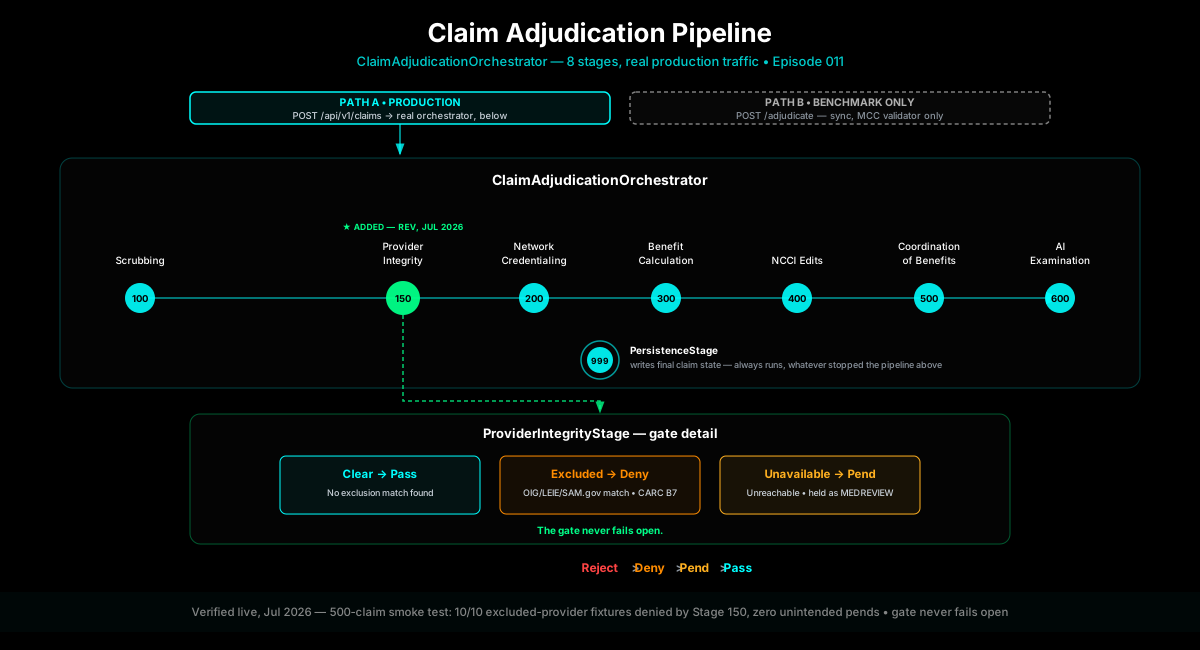
That endpoint is the standalone, synchronous benchmark surface this series' validator calls directly. It is not claims-service's production adjudication path. Real claims move through ClaimAdjudicationOrchestrator — a fixed, ordered pipeline of stages, triggered asynchronously off a ClaimVersionSubmitted event, the same pipeline every prior episode's throughput and correctness numbers were measured against. Its BenefitCalculationStage calls benefit-plan-service's calculate-benefits endpoint, which by design has never touched provider integrity — that endpoint is deliberately side-effect-free because portal and preview features call it too, and a live federal-exclusion check has no business running against a hypothetical calculation.
Put together: the federal OIG/LEIE/SAM.gov exclusion check has existed, and been correctly tested, since capability 5.10. It has simply never been reachable from a real submitted claim. Every ExcludedProviderDenied result this series has ever reported — including the clean 5,000/5,000 in Part 10's Round 3 — was scored against the benchmark's own synchronous call to /adjudicate, not against what claims-service's orchestrator actually decided. The orchestrator was never asked the question.
The fix: a gate that can't fail open, and a stage that finally asks it
Two changes, not one.
HttpProviderIntegrityGate no longer has a passthrough state at all. Every code path that used to return a default "clear" result now returns one of two things: a confirmed answer, or a new RequiresManualReview flag. Total unavailability, and a live "Failed" or "ManualReviewRequired" status, both now resolve to Passed = false, RequiresManualReview = true — distinct from IsExcluded, and distinct from a pass. The gate cannot silently clear a provider it never actually checked.
Getting that answer to a real claim needed a new door. Benefit-plan-service now exposes GET /api/v1/adjudication/provider-integrity/{npi}, a side-effect-free read that runs the exact same gate Adjudicate always has, without touching calculate-benefits. Claims-service calls it from a new pipeline stage, ProviderIntegrityStage, Order=150 — right after scrubbing, before network credentialing. A confirmed exclusion is a Deny. Anything the gate can't confidently resolve, including the HTTP call to benefit-plan-service itself failing, is a Pend using MEDREVIEW — a pend code and work-queue bucket that already existed for this exact purpose. No new pend vocabulary, no tenant-configurable fail-open mode. A federal exclusion check doesn't get an advisory-only setting.
Code review on the pull request caught a third bug before merge, in the same family as the first two: once the gate started returning Passed = false for both a confirmed exclusion and an unresolved review case, AdjudicationController.Adjudicate was still reporting both as PROVIDER_EXCLUDED — an outage or an inconclusive verification would have been denied as if the provider had actually appeared on a federal exclusion list. Fixed by checking IsExcluded explicitly before falling through to the general not-passed case, with four new tests covering exclusion, review-required, unavailable, and a defensive all-false result. The same discipline this series applies to its own benchmark claims — a reviewer's finding is a fact to check, not a fact to argue with.
Verified live, not just in the test suite
This episode is not a scale confirmation. There is no 250,000-claim run here, and nothing above claims about production capacity. What there is: proof, taken from the running system, that a claim submitted the way real claims are submitted now actually reaches this check.
POST /api/v1/claims is the entry point that triggers ClaimAdjudicationOrchestrator — and it happens to be the same call this series' own MCC validator already makes before it separately exercises the benchmark endpoint, so a normal validator run exercises both paths at once. A 500-claim run, including the validator's ten seeded ExcludedProviderDenied fixture claims, went through claims-service's real, async pipeline with the new stage active. Read directly from the running pods: ProviderIntegrityStage fired exactly ten Deny outcomes, each reading Provider is excluded from federal healthcare programs — a one-to-one match against the ten seeded fixtures, zero false positives, zero false negatives. GET /api/claims/{id} on one of them confirmed the persisted result: denialReasonCode: B7, the correct denial reason, claim status Denied. Zero errors in the provider-integrity path across the run. The false-pend sweep that already runs at the end of every MCC job reported zero unexpected pends — the new stage didn't introduce a single unintended side effect anywhere else in the run. The synchronous benchmark side stayed exactly as clean as Part 10 left it: 62 of 65 workflow checks matched, zero mismatched, ExcludedProviderDenied 10/10.
One environment detail belongs in this record rather than left implicit: this local Kubernetes environment has no Service Bus emulator provisioned. Claims-service's messaging auto-resolves to an in-process, in-memory bus, so the publish-to-subscribe hop that triggers the orchestrator happens inside the same pod that handled the HTTP request, not across a real broker. That's sufficient to prove the pipeline wiring and the stage's logic are correct — it is not evidence about broker behavior, delivery guarantees, or timing under a real Service Bus connection, which production configuration provides and this environment does not.
What this actually answers, and what it doesn't
Part 10's disclosed bug is closed, but not with the fix Part 10's own wording anticipated. The specific status-mapping path named in that disclosure wasn't reachable through the caller Part 10 was looking at. What was reachable, and worse, was a total-unavailability fail-open path in the same gate, and a complete absence of the check from claims-service's real pipeline. Both are fixed now. Neither would have been found by patching only the line Part 10 pointed at.
This does not change any throughput number this series has published. It does not add or remove a scale rung. What it changes is which of this series' own past correctness claims were actually being tested against production logic versus a benchmark-only stand-in — and going forward, ExcludedProviderDenied results are decided by the same orchestrator that decides every other claim in this series, not a parallel code path that happened to agree with it.
The road to one million
Part 6 made the scoring honest.
Part 7 made the evidence visible.
Part 8 proved a clean 100,000-claim run and found the next bottleneck.
Part 9 grew the scored surface without lowering the bar, and left a number unconfirmed.
Part 10 confirmed it, found the real cause wasn't the guessed one, and disclosed a bug it chose not to fix.
Part 11 went back for that bug, found it wasn't the whole story, and closed the gap it was hiding.
The next rung is still 500,000 claims, unchanged from where Part 10 left it — the first scale where the still-open Submit chain gets a harder test than 250K gave it. It now runs against a pipeline that actually checks every claim against federal exclusion lists, not one that happened to score correctly because a benchmark endpoint quietly did the checking on its behalf.