Running a Healthcare Claims Platform Locally in Kubernetes, Part 16: The Million Went Through the Bus
Part 15 reached the number this series had named from the beginning: one million claims. It also ended with an uncomfortable result. The clean re-run processed every claim with zero platform failures, but sustained throughput settled at 123.81 claims per second—well below shorter runs. Redis had been proven innocent after its memory fix. The gap was real, and unexplained.
Part 16 changes the path being measured.
The benchmark was still taking a synchronous shortcut
The validator submitted each claim through claims-service, but then called synchronous adjudication and wrote the result back itself. That was useful for deterministic scoring, and it helped build every correctness gate in this series. It was not the same thing as letting the platform's asynchronous claims pipeline own the work from submission to persisted disposition.
That distinction matters operationally. A real inbound claim should be accepted, published, consumed, adjudicated, and persisted without the submitting client orchestrating the middle of the workflow.
The new --servicebus-only mode does exactly that. It submits the structured claim to POST /api/v1/claims, waits for claims-service to publish the version event, lets Azure Service Bus deliver it to one of three local claims-service replicas, and polls only the persisted claim until it reaches a terminal status. Payment and workflow scoring come from that persisted result.

Making local Service Bus reproducible
Using a manually copied RootManage connection string would have made the benchmark work, but not made the environment reproducible. The local deployment now has an opt-in bootstrap path instead: configure the namespace, resource group, and location, and the script creates the claims entities, creates a least-privilege Listen/Send authorization rule, and installs its connection as servicebus-secret. Without those settings, local development keeps the in-memory bus.
The first Service Bus smoke test also found a quieter bug. The validation benefit plan has both a document GUID and a business planId. The synchronous path accepted the GUID the validator had always sent. The asynchronous plan resolver looked up the business identifier. Claims reached the bus correctly, then adjudicated without their configured network tier. The fix was not to teach the resolver to guess; it was to submit the identifier its contract already required.
One million, asynchronously
The final run used a fresh tenant, the full deterministic million-claim corpus, validator parallelism 96, three claims-service replicas, and 32 configured Service Bus calls per replica. Preparation seeded 962,936 members, 9,200 COB coverage rows, 135,598 providers, and 6,376 prior authorization fixtures. The authorization fixtures needed their own scale fix: one large seed request crossed the validator's 60-second HTTP timeout, so they moved to bounded batches of 500.
The timed result was 155.89 claims per second, with 910-millisecond P95 and 1,205-millisecond P99 latency. That is 25.9 percent faster than Part 15's clean million-claim result and 7.5 percent above the 145.04-per-second 250,000-claim record from Part 10.
The validator reported 999,878 processed and 122 platform failures. Every one of those failures was the same kind: the claim did not become terminal inside its 180-second observation window. They clustered in two brief periods. There were no submission failures, no dead letters, no pod restarts, and no claims-service error logs.
After the queue drained, MongoDB told the complete story: 1,000,000 claims, 1,000,000 terminal, zero nonterminal, and 2,000,000 lifecycle events. The validator had measured a deadline, not loss.
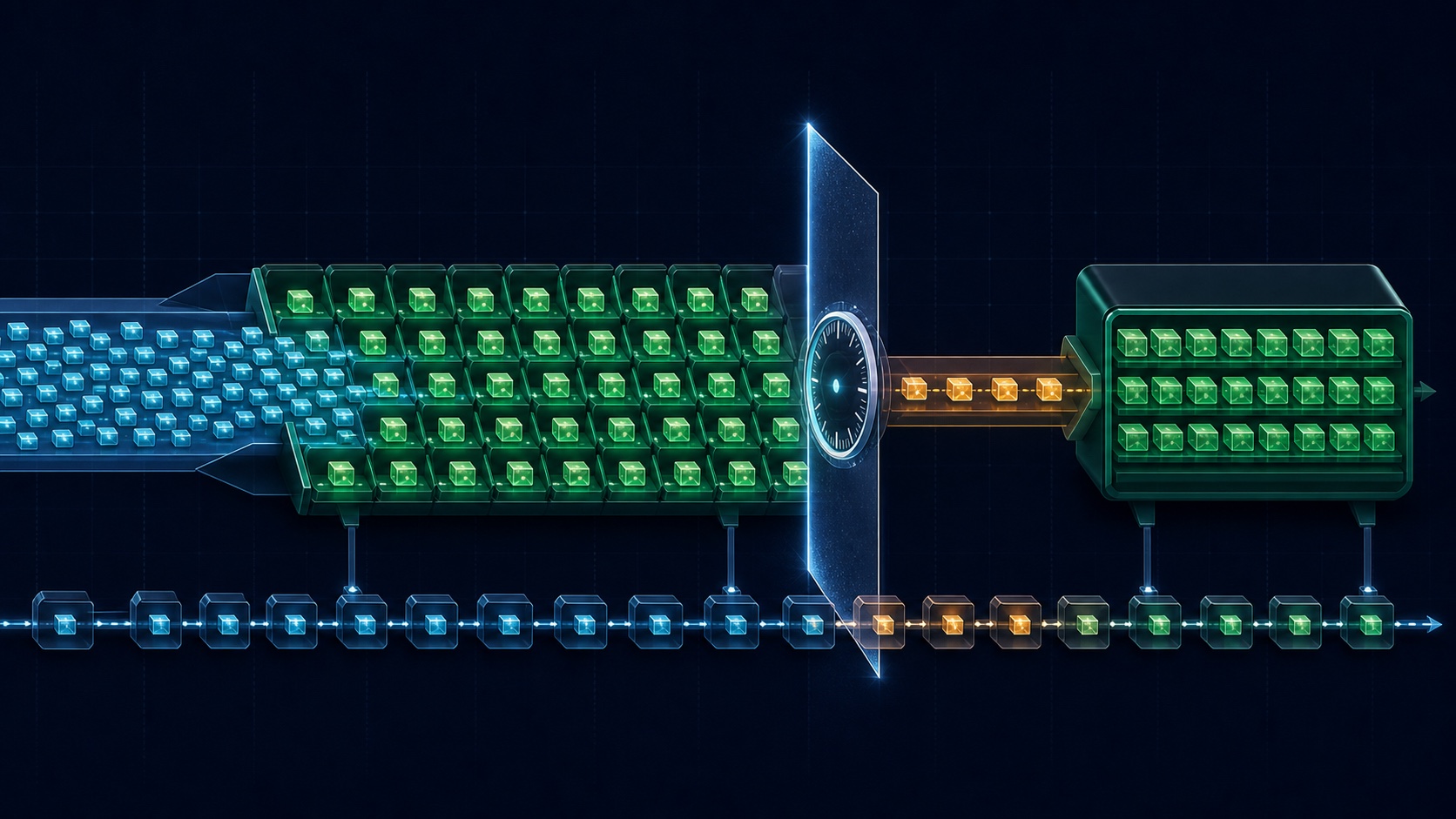
That does not make the 122 disappear from the published result. The validator exited nonzero, 20 workflow checks were not successfully scored inside the window, and 18 paid scenarios never entered the payment comparison. Part 15 remains the strict zero-platform-failure million-claim baseline. Part 16 is the faster asynchronous result with 100 percent eventual completion and a new validator limitation made visible.
MCC still was not an 837 test
There was one more boundary to make explicit. MCC submits structured JSON. It deliberately avoids EDI parsing so its answer key can isolate adjudication behavior. Running a million MCC claims cannot prove that an evaluator can drop a real 837 file into the platform.
So the raw onramp got its own test.
A single 16.1-megabyte X12 837P file containing 100,000 claims went to POST /api/v1/claims/import/raw837 with importer concurrency 64. The parser mapped every claim, the importer created 100,000 claim records and 100,000 import transactions, Service Bus carried the work to adjudication, and MongoDB recorded 200,000 lifecycle events.
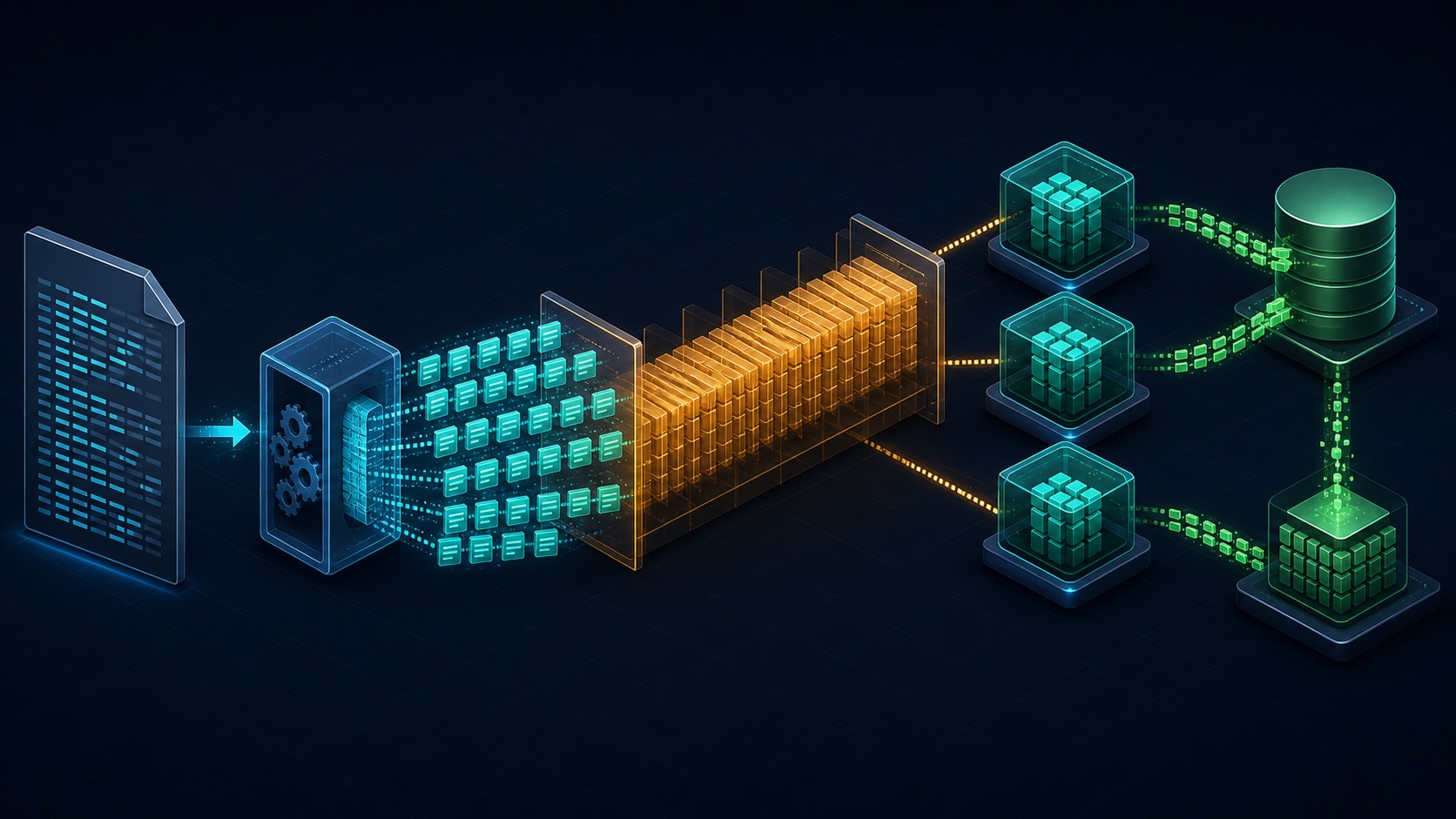
All 100,000 claims were accepted. All 100,000 reached a terminal state. Parsing and submission took 299.77 seconds—333.59 claims per second. The last adjudication event arrived 501.45 seconds after the request began, for 199.42 claims per second end-to-end. The subscription drained to zero active and zero dead-letter messages. All three claims pods stayed up with zero restarts and no matching error logs.
Every claim ended in the same business-denial status because this scale fixture deliberately reused a known COB-secondary claim. That is not a diverse correctness corpus and it should not be presented as one. It is proof of the complete technical onramp: raw X12, parser, mapper, claim submission, Service Bus, adjudication, persistence, and audit evidence.
The prior clean raw-837 run at concurrency 32 reached 139.09 claims per second end-to-end. Concurrency 64 reached 199.42 at ten times the claim count—a 43.4 percent improvement without a dead letter or lost claim.
What the numbers mean now
Part 15's open sustained-throughput question has an answer: the asynchronous Service Bus path can carry the full mixed corpus faster than the prior client-orchestrated path on this local cluster. It is not a production capacity claim, and it does not erase the difference between a fixed observation deadline and eventual completion.
The raw 837 result answers a different question: the EDI front door can feed that asynchronous pipeline at sustained six-figure volume, and at p64 the importer is faster than the consumers behind it. The observed Service Bus backlog peaked around 39,000 messages, then drained completely. That is what a queue is for.
The next work is no longer "can it reach one million?" It is making the evidence system understand late completion without manual database reconciliation, and repeating these paths in AKS when subscription quota is available.