CMS-0057-F Implementation Architecture for Health Plans
Compliance is more than exposing a few endpoints. A payer needs FHIR APIs, identity and security, prior authorization workflows, terminology and reference data, integration with existing operational systems, observability, and governance — working together as one architecture.
This guide is the technical answer to a harder question than “What is CMS-0057-F?” It is how a health plan actually implements it across FHIR APIs, prior authorization, Da Vinci workflows, reference data, identity, and existing core administration systems.
What CMS-0057-F changes for payer architecture
CMS-0057-F is often read as an API checklist. In practice it changes where a health plan's data has to flow, who is allowed to reach it, and how quickly the plan has to respond — which is an architectural problem, not a point solution.
The rule requires impacted payers — Medicare Advantage organizations, state Medicaid and CHIP programs, and Qualified Health Plan issuers on the federal Marketplaces — to expose standardized HL7 FHIR R4 APIs and to modernize prior authorization, with most provisions carrying a compliance date of January 1, 2027. Meeting that date means opening the plan's operational data to external consumers it never previously served directly, and doing so without destabilizing the systems that run the business.
That pulls in nearly every part of the payer stack:
- External API consumers — member-authorized patient apps, in-network providers, and other payers now request data over FHIR on the member's behalf.
- Payer operational systems — claims, encounters, member, and provider data have to be reachable, current, and correctly scoped.
- Legacy core platforms — the core administration system of record continues to run adjudication and enrollment while new FHIR surfaces read from and write to it.
- Utilization management — prior authorization decisions have to connect to existing medical policy and review workflows, not bypass them.
- Claims and encounters — the Patient Access and Provider Access APIs surface adjudicated claims and encounter history under USCDI.
- Member and provider data — identity, attribution, and directory data have to be consistent across every API.
- Prior authorization — CRD, DTR, and PAS turn a fax-and-phone process into an interoperable, auditable FHIR workflow.
- Interoperability — payer-to-payer exchange has to move a member's history when they change plans.
- Security — every request has to be authenticated, authorized, scoped, and consent-aware.
- Auditability — access and decisions have to be logged and reportable to demonstrate compliance.
Treating these as ten separate projects produces ten brittle integrations. Treating them as one architecture — a stable FHIR boundary with shared identity, terminology, and audit in front of the payer's operational systems — is what makes the program maintainable past the compliance date.
A reference architecture for CMS-0057-F
The architecture separates the regulated boundary from the systems of record. External consumers only ever see a stable FHIR surface; the operational systems behind it can change without breaking that contract.
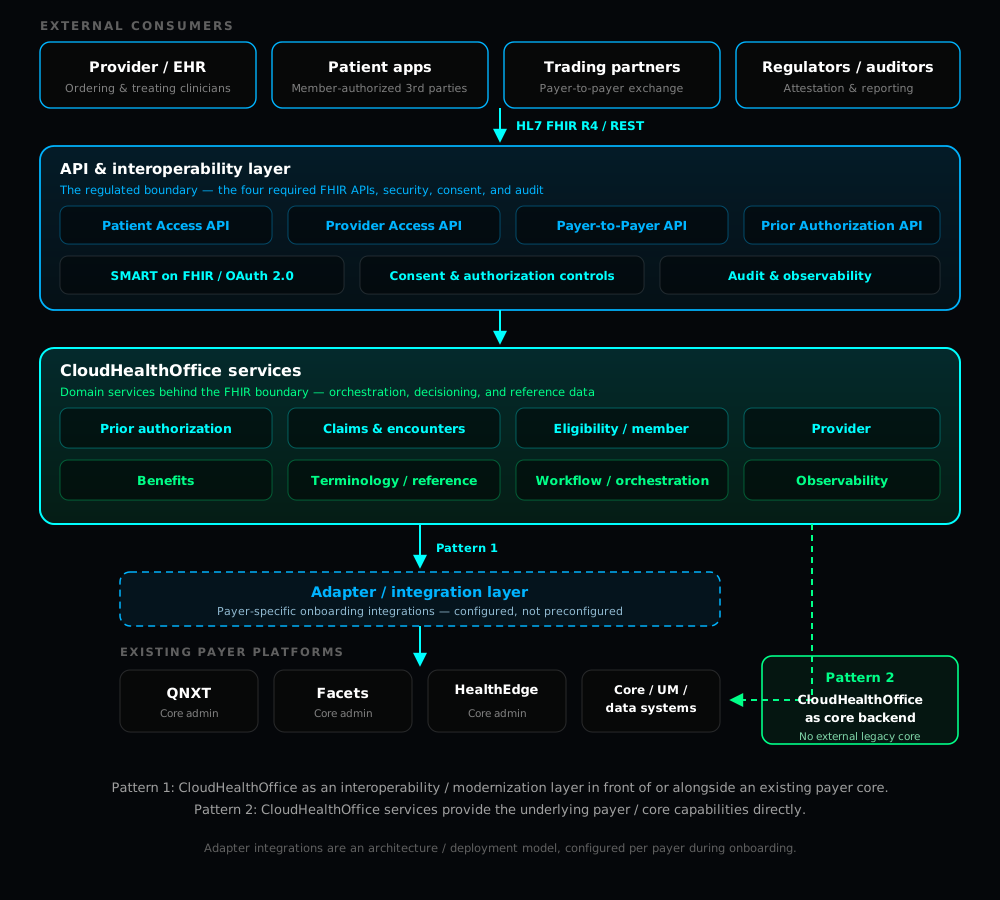
The regulated boundary
Provider, EHR, patient, and trading-partner traffic enters over FHIR R4. The API & interoperability layer hosts the four required APIs together with SMART on FHIR / OAuth 2.0, consent and authorization controls, and audit and observability. This is the only surface external consumers ever touch.
Services and integration
Cloud Health Office services — prior authorization, claims, eligibility/member, provider, benefits, terminology, workflow, and observability — implement the behavior behind the APIs. They either integrate an existing core through the adapter layer (Pattern 1) or act as the core backend directly (Pattern 2).
Honest scoping: the adapter / integration layer is an architecture and deployment model. Connections to a specific core administration platform are payer-specific onboarding integrations configured during implementation — not universal preconfigured connectors. The distinction between implemented platform capabilities and per-payer integration work is made explicit throughout this guide.
Patient Access, Provider Access, Payer-to-Payer, Prior Authorization
CMS-0057-F centers on four FHIR R4 APIs. Cloud Health Office implements all four as a platform capability; each payer's data mapping is configured during onboarding. The CMS-0057-F compliance overview maps each API to its FHIR resources in detail.
Patient Access API
Claims, encounters, and clinical data delivered to member-authorized apps under USCDI, secured with SMART on FHIR consent.
See the requirements → API 2Provider Access API
Member data made available to in-network providers, with attribution and opt-out handling built into the boundary.
See the requirements → API 3Payer-to-Payer API
Member history exchanged between plans at enrollment, so coverage transitions carry claims and clinical context forward.
See the requirements → API 4Prior Authorization API
Authorization status, decisions, and rationale exposed over FHIR — the surface for the Da Vinci CRD/DTR/PAS workflow below.
See the requirements →Prior authorization with CRD, DTR, and PAS
The Prior Authorization API is the visible surface; the HL7 Da Vinci implementation guides are the workflow behind it. Three guides turn prior authorization from a fax-and-phone exchange into an interoperable, auditable sequence.
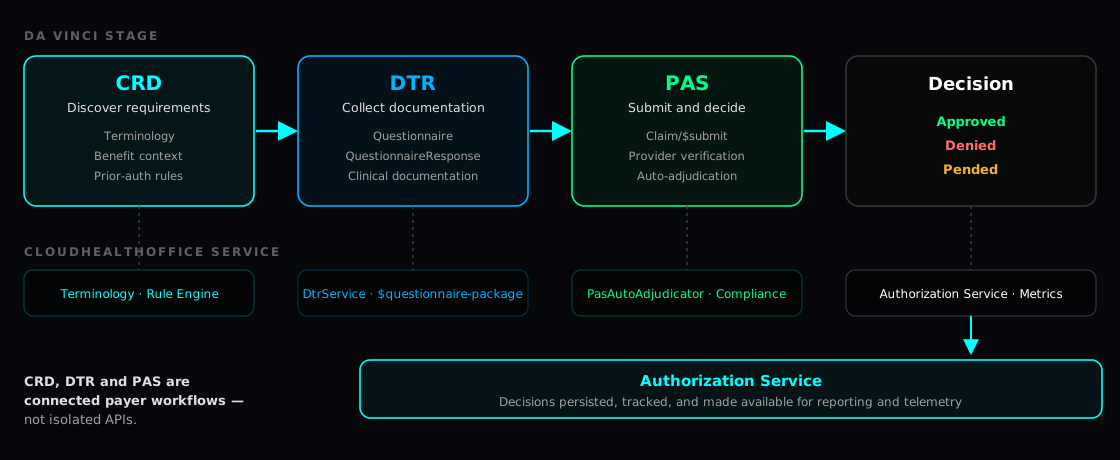
CRD
Coverage Requirements Discovery. Through CDS Hooks, the payer tells the provider at order-select and order-sign whether authorization is required and what documentation applies.
DTR
Documentation Templates & Rules. FHIR Questionnaire and QuestionnaireResponse workflows collect exactly what the payer needs, prefilled from clinical data where possible.
PAS
Prior Authorization Support. The request is submitted over FHIR (mapped to X12 278 where required), validated, routed to review, and a decision with rationale is returned.
This is a concise introduction on purpose. For the full end-to-end workflow — including how CRD, DTR, and PAS integrate with QNXT, Facets, and HealthEdge — see the dedicated pillar article and the implementation guide.
CRD, DTR, PAS with QNXT, Facets & HealthEdge
How Cloud Health Office implements the Da Vinci workflow alongside — or as — a payer core.
Read the article → Implementation GuidePrior Authorization Guide
The end-to-end FHIR prior authorization workflow, from discovery to decision.
Read the guide →FHIR and payer interoperability
For a payer, FHIR is not a database format — it is the contract between external consumers and internal operational systems. The value is in what that contract lets you change without breaking callers.
A health plan's operational data lives in adjudication engines, enrollment systems, care-management tools, and data warehouses that were never designed to be queried by a member's phone app. FHIR becomes the translation and stability layer between those systems and the outside world: external consumers speak a single, versioned resource model, while the plan is free to source each resource from whichever internal system owns it.
Implemented well, that boundary gives a payer three things the underlying systems can't provide on their own:
- A stable external contract. Patient Access, Provider Access, and Payer-to-Payer callers depend on FHIR resources, not on the core's internal schema — so the core can be modernized or replaced without a coordinated external migration.
- Consistent semantics across sources. A
Claim,Coverage, orExplanationOfBenefitmeans the same thing whether it originated in claims, enrollment, or a warehouse, because the mapping and terminology are enforced at the boundary. - A single place to apply policy. Security, consent, scoping, and audit are enforced once at the FHIR layer rather than reimplemented in every backend integration.
This is why the reference architecture puts the FHIR APIs above the services and the core: the interoperability layer is what lets a payer meet an external, regulated contract while the systems of record evolve on their own timeline.
Terminology and reference data
Payer APIs are only as trustworthy as the codes inside them. Consistent terminology is what makes a FHIR resource returned to a provider mean the same thing as the code adjudicated in the core.
Every one of the four APIs depends on shared reference data. When a provider's system reads a coverage requirement, or a member's app renders an explanation of benefits, the codes have to resolve consistently across systems that were built independently. That requires the plan to manage, as first-class infrastructure:
- Code systems — SNOMED CT, LOINC, ICD-10-CM, CPT, and HCPCS with correct versioning.
- Value sets — the bounded sets of codes valid for a given element or workflow.
- Procedure codes and diagnoses — carried consistently from order through authorization to claim.
- Benefit and reference data — plan, network, and cost-sharing references the APIs resolve against.
- Mappings — crosswalks such as SNOMED CT to ICD-10-CM or CPT via
ConceptMap/$translate. - Validation — rejecting resources that carry codes outside their required value sets before they ever reach a consumer.
Without a terminology service, each integration re-implements its own mappings and they drift apart. Cloud Health Office provides FHIR-native terminology and crosswalk services so the same codes resolve identically across the prior authorization, claims, and access APIs. The terminology guide shows the translation workflows in detail.
Integrating existing core administration systems
Most impacted payers already run a core administration platform. The architecture is designed so CMS-0057-F does not force a rip-and-replace — while leaving the door open to modernization when the plan is ready.
Cloud Health Office supports two deployment patterns for the systems of record. In the interoperability / modernization pattern, Cloud Health Office sits in front of or alongside an existing payer core and integrates through the adapter layer, providing modern FHIR and prior-authorization capabilities without replacing the core. In the Cloud Health Office-as-core pattern, the platform's own claims, eligibility, provider, benefits, prior authorization, and terminology services participate directly as the backend. The commercial ladder for those patterns is Foothold, Domain cutover, and Core — see the layers on /platform.
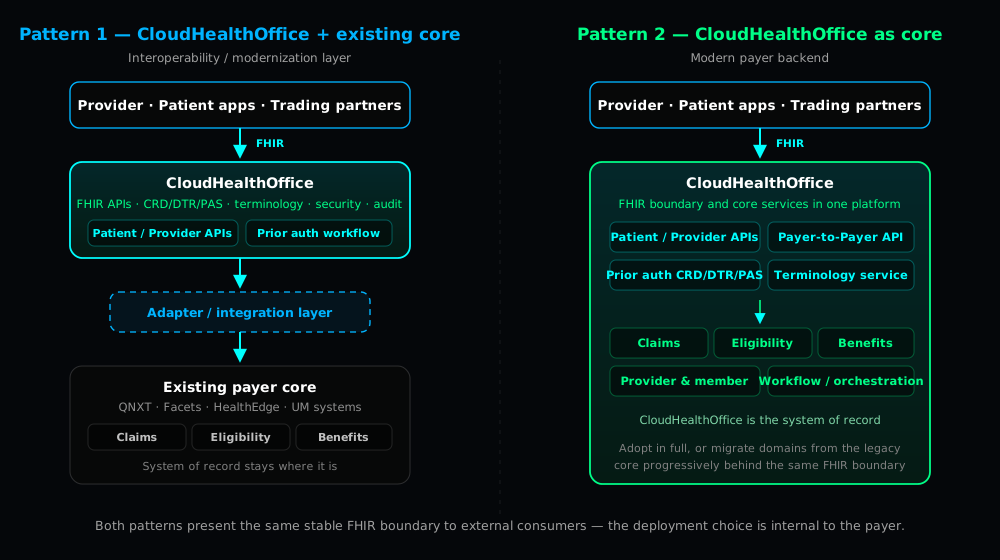
| Consideration | Cloud Health Office + existing core | Cloud Health Office as core |
|---|---|---|
| System of record | Existing core (QNXT, Facets, HealthEdge, or other) keeps claims, eligibility, and benefits. | Cloud Health Office services own claims, eligibility, benefits, provider, and prior authorization. |
| FHIR boundary | Provided by Cloud Health Office above the core. | Provided by Cloud Health Office as part of the platform. |
| Integration work | Adapter-based, payer-specific, configured during onboarding. | Domain configuration rather than external core integration. |
| Change to core | None required to meet the rule; modernize later on your timeline. | Adopt in full, or migrate domains from the legacy core progressively. |
| Best fit | Plans meeting the 2027 date without disrupting operations. | Plans that want a modern, FHIR-native backend architecture. |
What is implemented vs. configured: the FHIR APIs, prior-authorization workflow, terminology services, and the adapter model are implemented platform capabilities. Integration with a specific named core administration platform is per-payer onboarding work. This guide does not imply that a turnkey QNXT, Facets, or HealthEdge connector ships preconfigured.
Security and identity
CMS-0057-F opens payer data to external consumers, which makes identity and access control part of the architecture rather than a deployment afterthought. Every request has to prove who is asking, on whose behalf, and for what.
The security model spans the external boundary and the internal service mesh:
- OAuth 2.0 — the authorization framework for every external API call, issuing scoped, expiring access tokens.
- Authentication — SMART on FHIR app registration and launch flows establish who the caller is before any data is returned.
- Authorization — access decisions bind the token, the member's consent, and the resource being requested.
- Service-to-service identity — internal calls between the FHIR layer, services, and adapters carry their own verifiable identity, not shared secrets.
- Scopes and permissions — SMART scopes constrain each app to exactly the resources and actions it was granted.
- Auditing — every access and prior-authorization decision is logged in a form that can be reported for compliance.
- Tenant isolation — in a multi-tenant deployment, one plan's data is never reachable from another's context.
- Least privilege — every component, human and machine, gets the minimum access its role requires.
These are real deployment considerations, not abstractions: a Patient Access request from a consumer app and a Provider Access request from an in-network clinic are authorized differently, and payer-to-payer exchange introduces a third trust relationship. Enforcing all three consistently at the FHIR boundary — with audit behind it — is what makes the APIs safe to expose. The trust and security overview describes the platform's controls.
Observability and operational readiness
A regulatory API that is deployed but unmonitored is a liability. These are production systems that external parties depend on, with a regulatory obligation behind their availability.
Once the APIs are live, the work shifts from building to operating. A member's app failing to load claims, a provider's authorization request timing out, or a payer-to-payer exchange silently dropping records are all operational incidents with compliance consequences. Readiness means the plan can see that behavior in real time — latency, error rates, and throughput per API — and has defined alerting and incident response before it is needed, not after the first outage.
That is why observability is a layer in the reference architecture, not an add-on: the same boundary that enforces security also emits the signals that prove the APIs are healthy and the audit trail that proves they are compliant. The observability, alerting & incident response runbook covers monitoring, paging, and response, and the production readiness checklist gathers the operational gates before go-live.
A phased implementation roadmap
A practical sequence for getting from today's core to a compliant, operable CMS-0057-F implementation — each phase building on the boundary established by the last.
Inventory systems and data
Map where member, provider, claims, encounter, benefit, and authorization data live today, and which system owns each. This inventory determines every adapter and mapping that follows.
Establish the FHIR / interoperability boundary
Stand up the FHIR R4 layer as the stable external contract, with resource models and the terminology service in place before any external consumer is onboarded.
Identity and security
Implement OAuth 2.0, SMART on FHIR registration and launch, scopes, consent, service-to-service identity, tenant isolation, and audit — the gate every API call passes through.
Patient, Provider, and Payer-to-Payer APIs
Deliver the three access APIs against the boundary, wiring each FHIR resource to its owning system and enforcing attribution, consent, and opt-out.
Prior authorization: CRD, DTR, PAS
Implement the Da Vinci workflow and expose it through the Prior Authorization API — discovery at ordering, documentation capture, submission, and decisioning.
Integrate core and UM systems
Connect the adapter layer to the existing core and utilization-management systems so decisions and data flow to and from the systems of record — or stand up Cloud Health Office services as the backend.
Testing, monitoring, and auditability
Validate against the implementation guides, load-test the APIs, wire observability and alerting, and confirm the audit trail is complete and reportable.
Production readiness
Clear the operational gates — incident response, disaster recovery, and sign-off — before routing production traffic and attesting to compliance.
Cloud Health Office deployment patterns
The same architecture supports several adoption paths. Which one fits depends on how much of the core a plan wants to modernize, and how quickly.
Augment the existing stack
Cloud Health Office provides the FHIR APIs, prior-authorization workflow, terminology, security, and audit in front of an existing core. The core stays the system of record; the plan meets the rule without disrupting operations. Integration is configured through the adapter layer during onboarding.
Staged modernization
Start by augmenting, then migrate domains — claims, eligibility, benefits — from the legacy core to Cloud Health Office services one at a time, behind the same FHIR boundary, so external consumers see no change as the backend moves.
Full Cloud Health Office backend
For a modern, FHIR-native architecture, Cloud Health Office services provide the underlying payer capabilities directly, with no external legacy core. The FHIR boundary and the systems of record are one platform.
What we do — and don't — claim
Cloud Health Office is not only a core-replacement platform. It is an interoperability and modernization layer and, when a plan wants it, a modern backend. Named-core integrations are described as an architecture and deployment model configured per payer — not as finished, shipped connectors.
Frequently asked questions
The questions payer architects and health-plan technology leaders ask most when scoping a CMS-0057-F implementation.
Does CMS-0057-F require replacing a payer core administration system?
Can CMS-0057-F be implemented with QNXT?
Can CMS-0057-F be implemented with Facets?
Can CMS-0057-F be implemented with HealthEdge?
Where do CRD, DTR, and PAS fit?
Is FHIR alone enough for CMS-0057-F compliance?
How does a payer integrate prior authorization with existing UM systems?
Can Cloud Health Office run alongside an existing core platform?
Can Cloud Health Office serve as the backend core platform?
Related guidance & references
This pillar connects the CMS-0057-F readiness overview to the implementation guides and platform documentation behind it.
CMS-0057-F Compliance
The vendor-neutral readiness layer, the four required FHIR APIs, and what CMS-0057-F requires of impacted payers.
Explore readiness → Insights SeriesCMS-0057-F & Payer Modernization
Architecture and implementation guidance for CRD, DTR, PAS, terminology, and legacy-core modernization.
Read the series → Implementation GuidePrior Authorization Guide
How CRD, DTR, and PAS come together into an end-to-end FHIR prior authorization workflow.
Read the guide → Implementation GuideClaims Guide
How claims and encounters are adjudicated and surfaced to the Patient and Provider Access APIs.
Read the guide → Implementation GuideEligibility Guide
Member and eligibility data behind the access APIs and prior-authorization workflow.
Read the guide → Implementation GuideTerminology & Crosswalk
FHIR-native SNOMED CT, ICD-10-CM, and CPT translation with ConceptMap/$translate.
API Documentation
The platform's FHIR and operational API surface for developers and integrators.
Browse the APIs → ArchitecturePlatform Architecture
How the services fit together — FHIR surface, terminology, rule engine, and payer integration.
See the architecture → EvidenceMillion Claim Challenge
How the platform's claims engine was validated at scale — one million claims, repeatably.
See the evidence → Get StartedQuickstart
Stand up the platform and exercise the FHIR surface in a working environment.
Start building →Implement CMS-0057-F on an architecture that lasts past 2027.
See how Cloud Health Office establishes a stable FHIR boundary in front of your existing core — or becomes the modern backend itself — on your CMS-0057-F timeline.