CMS-0057-F Compliance Guide
Cloud Health Office delivers a CMS-0057-F readiness surface — FHIR R4 APIs, X12 EDI mapping, SNOMED–CPT–ICD terminology translation, and multi-source provider verification — designed to be validated alongside existing payer core admin systems.
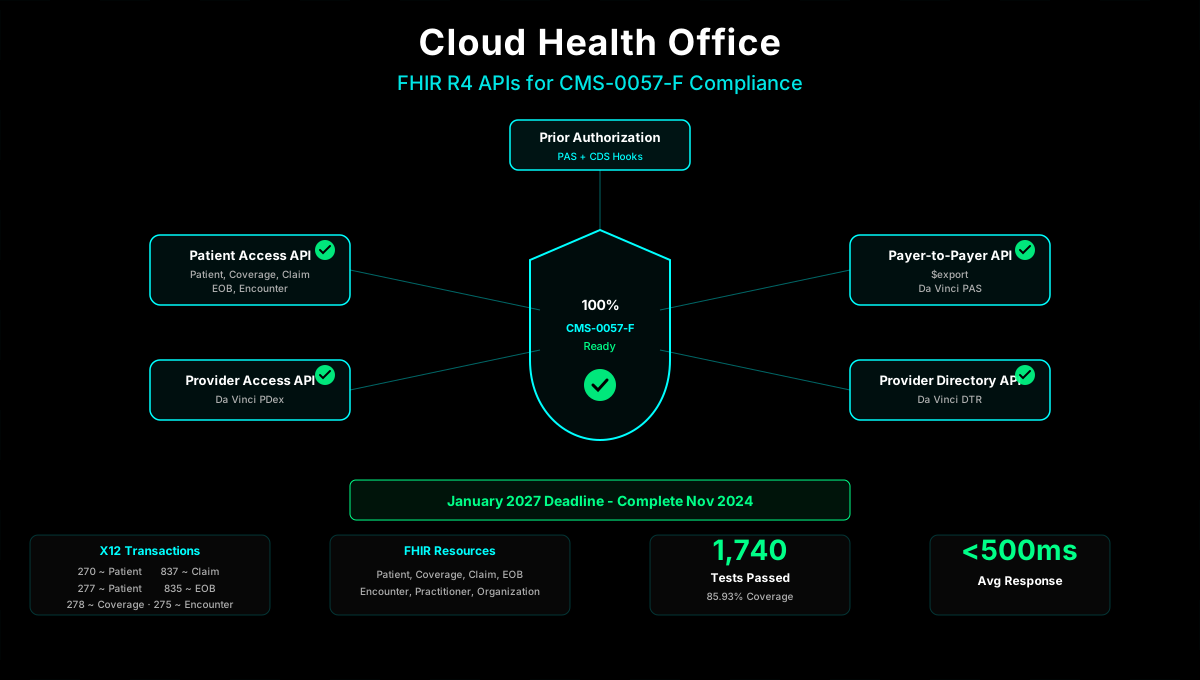
What is CMS-0057-F?
CMS-0057-F (Advancing Interoperability and Improving Prior Authorization Processes) is a final rule requiring health plans to implement specific FHIR R4 APIs to improve prior authorization workflows, reduce provider burden, and enhance patient care coordination.
Non-compliance penalties can reach up to $1M per violation. The rule applies to Medicaid MCOs, Medicare Advantage plans, CHIP programs, and QHP issuers on the federal exchange.
All impacted payers must have Patient Access, Provider Access, Payer-to-Payer, and Prior Authorization APIs live in production by this date. Cloud Health Office is designed to help payers stand up and validate that readiness surface without replacing the core admin system first.
Achieving compliance requires more than standing up four FHIR endpoints. The rule depends on Da Vinci Implementation Guides (PAS, CRD, DTR, PDex) that exchange clinical data in SNOMED CT — a code system that payer core admin platforms do not natively speak. It also requires provider directory accuracy and real-time eligibility verification against validated provider records. CHO is built to address the full compliance surface in a single deployable stack: APIs, EDI transformation, terminology translation, and provider data integrity.
Compliance Dashboard
CMS-0057-F coverage is validated through automated tests and implementation artifacts spanning FHIR API conformance, X12 EDI parsing, claims adjudication, benefit calculation, terminology translation, and provider verification.
| Requirement | Status | Tests | Da Vinci IG |
|---|---|---|---|
| Patient Access API | Complete | 19 FHIR tests | PDex 2.0+ |
| Provider Access API | Complete | 8 FHIR tests | PDex 2.0+ |
| Payer-to-Payer API | Complete | 6 FHIR tests | PDex (Bulk $export) |
| Prior Authorization API | Complete | 12 FHIR tests | PAS 2.0.1 + CRD + DTR |
| 72-Hour Urgent Response | Automated | Compliance Checker | — |
| 7-Day Standard Response | Automated | Compliance Checker | — |
| USCDI v1/v2 Data Classes | Complete | Data Class Mapping | US Core 3.1.1+ |
| Terminology Translation (SNOMED ↔ CPT/ICD) | Complete | ConceptMap/$translate | FHIR R4 ConceptMap |
| Provider Verification & Directory | Complete | Integrity Score Engine | Da Vinci PDex Plan-Net |
| OAuth 2.0 / SMART on FHIR | Complete | Auth flow tests | SMART App Launch |
| X12 EDI ↔ FHIR Bidirectional | Implemented | Mapping and parser coverage | — |
| Claims Adjudication Pipeline | Evidence-backed | MCC benchmark runs | — |
Required APIs
Patient Access API
Empowers patients to access their complete health data electronically — claims history, Explanation of Benefits, clinical data, coverage, and eligibility. Transforms X12 837/835 transactions into FHIR Claim and ExplanationOfBenefit resources conforming to Da Vinci PDex profiles. Secured with OAuth 2.0 patient consent flow via SMART on FHIR. Includes USCDI v1 and v2 data class coverage for clinical data exchange.
Provider Access API
Gives in-network providers access to member clinical and claims data with appropriate consent. Implements Da Vinci PDex with $member-match for patient identification across payers without sharing raw identifiers. Provider identity is validated against CHO's multi-source provider verification engine before data access is granted.
Payer-to-Payer API
Enables data exchange when members switch health plans. Supports Bulk FHIR $export for efficient batch transfer of member records — including five years of historical data — between payers while maintaining HIPAA compliance. Enrollment-triggered workflows automate the initiation of data transfer on member plan changes.
Prior Authorization API
Converts the prior auth workflow from phone/fax to real-time FHIR-based requests. Full X12 278 bidirectional mapping to FHIR ServiceRequest using Da Vinci PAS, CRD, and DTR implementation guides. Automates the 72-hour urgent and 7-day standard response timelines required by the rule. Decision rationale is captured and returned as structured data per CMS requirements.
The Prior Authorization API depends on three foundational capabilities that most competing implementations leave as “customer responsibility”:
- Coverage Requirements Discovery (CRD) — Real-time coverage rules evaluated during the provider workflow via CDS Hooks. Requires SNOMED-to-CPT/ICD translation to match clinical codes against payer benefit configuration. CHO's Terminology Crosswalk handles this natively.
- Documentation Templates & Rules (DTR) — FHIR Questionnaire and QuestionnaireResponse for automated clinical documentation collection. Questionnaire answer codes are resolved across code systems by the crosswalk engine so pre-populated values are clinically accurate and machine-readable.
- Provider Identity Verification — Authorization requests must be validated against credentialed, non-excluded providers. CHO's Provider Verification engine screens against NPPES, OIG/LEIE, PECOS, and state licensing boards in real time.
X12 to FHIR R4 Transformation
Cloud Health Office includes X12-to-FHIR mapping surfaces for core payer transactions. Some paths are implemented directly in the platform and the X12 container uses purpose-built parsing support where appropriate; production use should validate companion guides, trading-partner variations, and payer-specific mappings.
| X12 Transaction | FHIR Resource | Profile | Status |
|---|---|---|---|
| X12 270/271 Eligibility | Patient, CoverageEligibilityRequest/Response | US Core 3.1.1 | Implemented |
| X12 837 Claims (I/P/D) | Claim | Da Vinci PDex | Implemented |
| X12 835 Remittance | ExplanationOfBenefit | Da Vinci PDex | Mapped |
| X12 278 Prior Auth | ServiceRequest, ClaimResponse | Da Vinci PAS | Implemented |
| X12 276/277 Claim Status | Claim (status query) | US Core | Implemented |
| X12 275 Attachments | DocumentReference | US Core | Implemented |
| X12 834 Enrollment | Coverage, Patient | US Core | Implemented |
Terminology Translation
CMS-0057-F's Da Vinci workflows (CRD, DTR, PAS) exchange clinical data in SNOMED CT — the terminology used by EHRs and clinical decision support systems. But payer core admin platforms (QNXT, Facets, HealthEdge, Amisys) store and adjudicate claims using CPT and ICD-10-CM codes. This terminology gap is the most commonly overlooked compliance obstacle.
Without built-in terminology translation, a prior authorization request containing SNOMED CT code 73211009 (Diabetes mellitus) cannot be matched to the payer's ICD-10-CM benefit configuration (E11.9, E10.9, etc.). Most implementation vendors treat this as “out of scope” or “customer responsibility” — leaving payers to build their own translation layer or purchase a separate product. CHO solves it natively.
CHO's Terminology Service implements the FHIR R4 ConceptMap/$translate operation with a multi-tier mapping architecture:
| Data Source | Mapping Direction | Entries | License |
|---|---|---|---|
| NLM / UMLS | SNOMED CT → ICD-10-CM | ~119,000 | Free (UMLS license) |
| AMA Cross Maps | CPT ↔ SNOMED CT | Varies | Customer-provided (BYOL) |
| Plan-Specific Overrides | Any direction | Varies | Tenant-scoped |
Context-aware disambiguation
Many SNOMED CT concepts map to multiple target codes. SNOMED 73211009 (Diabetes mellitus) can map to E10.x (Type 1), E11.x (Type 2), E13.x (Other specified), or O24.x (Gestational). CHO's context rule engine uses patient demographics, co-morbidities, and plan-specific coding policy to select the best match — not just the first match.
| Context Signal | Effect | Example |
|---|---|---|
| Patient age | Selects age-appropriate codes | Juvenile diabetes (E10.x) for patients under 18 |
| Patient gender | Excludes gender-impossible codes | Prostate conditions excluded for female patients |
| Patient state | Applies state-specific rules | Texas TMPPM coding conventions |
| Active conditions | Co-morbidity-aware selection | Diabetes + CKD selects E11.22 over E11.9 |
| Plan overrides | Tenant-scoped coding policy | Plan maps 73211009 to E11.65 for all members |
Where the crosswalk fits in CMS-0057-F
The Terminology Service is consumed by three CHO microservices at runtime to fulfill CMS-0057-F requirements:
- CRD Server — Translates SNOMED CT codes from EHR CDS Hook requests into the payer's CPT/ICD code space, then checks against benefit configuration to determine prior auth requirements.
- PAS Server — Translates procedure and diagnosis codes during X12 278 ↔ FHIR conversion using
$batch-translatefor low-latency bulk translation in real-time prior auth decisions. - DTR Engine — Resolves questionnaire answer codes across code systems so pre-populated FHIR QuestionnaireResponse values are clinically accurate and machine-readable.
For the complete API reference, map management, context rule engine, and portal integration details, see the Terminology Crosswalk Guide. To see live translations in a guided session, contact Sales to schedule a walkthrough.
Provider Verification & Integrity
CMS-0057-F requires a Provider Directory API and provider data accuracy for the Provider Access API. Authorization requests, claims adjudication, and provider directory lookups all depend on verified, current provider records. CHO's Provider Verification Engine aggregates data from five authoritative federal and state sources into a composite Provider Integrity Score (0–100) per NPI.
| Data Source | What It Checks | Update Frequency |
|---|---|---|
| NPPES (NPI Registry) | NPI validity, practice address, taxonomy, enumeration status | Daily |
| OIG / LEIE | Federal exclusion screening — excluded providers cannot participate in federal programs | Monthly |
| PECOS | Medicare enrollment status and participation eligibility | Monthly |
| CMS Open Payments | Industry relationship disclosure for transparency and conflict-of-interest awareness | Annually |
| FSMB / State Licensing | Active medical license verification, disciplinary actions, multi-state compact status | Varies by state |
The composite score is computed using a weighted algorithm across all five sources. Providers below a configurable threshold (default: 60) are flagged for review. Excluded providers (OIG/LEIE match) are automatically blocked from authorization and claims processing. All verification results are audit-logged with timestamps and source data versions for compliance documentation.
Where provider verification fits in CMS-0057-F
- Provider Access API — Provider identity is verified before granting access to member clinical and claims data. NPI is validated against NPPES, exclusion status is checked against OIG/LEIE, and license status is confirmed.
- Prior Authorization API — Requesting and servicing provider NPIs are verified during X12 278 processing. Excluded or unlicensed providers trigger an automatic deny with structured rationale.
- Provider Directory API — Directory entries are enriched with verification metadata, ensuring that provider information exposed through FHIR endpoints reflects current, validated data.
- Claims Adjudication — Step 4 of the 10-step adjudication pipeline validates the servicing provider before benefit calculation proceeds.
For the complete scoring algorithm, bulk sync infrastructure, API reference, and portal integration, see the Provider Verification Guide.
State-Level Compliance
Beyond federal CMS-0057-F requirements, CHO ships with state-specific compliance rules that apply automatically to tenants operating in those states. Platform-level seed rules enforce state regulatory floors — tenants can override parameters or disable rules, but cannot delete platform rules.
Why Cloud Health Office
CMS-0057-F compliance is not just an API problem — it is an integration, terminology, data quality, and adjudication problem. Most implementation approaches address only the FHIR API surface and leave the rest as “customer responsibility.” CHO addresses the full compliance surface in a single platform.
| Capability | CHO | Typical Implementation |
|---|---|---|
| FHIR R4 APIs (Patient, Provider, P2P, PA) | Built-in | Varies — often assembled from open-source tooling |
| X12 EDI Mapping | Implemented mapping surfaces | Third-party libraries or manual mapping |
| SNOMED ↔ CPT/ICD Terminology Translation | Native ConceptMap/$translate | Not included — “customer responsibility” |
| Context-Aware Disambiguation | Rule engine with plan overrides | Not available |
| Provider Verification (NPPES, OIG, PECOS, FSMB) | Multi-source Integrity Score | Manual or separate product |
| Claims Adjudication Pipeline | 10-step DAG, <500ms | Depends on legacy CAPS |
| Benefit Engine (HDHP, HSA, COB, NCCI, DRG) | 9 calculation engines | Depends on legacy CAPS |
| Core Admin Adapter Pattern | Vendor-neutral ICoreAdminAdapter | Hard-coded to one CAPS |
| Multi-Tenant SaaS | X-Tenant-ID isolation | Single-tenant or per-client deployment |
| Evaluation Timeline | <1 hour local start | 6–18 months |
CHO deploys as a compliance layer alongside your existing core admin platform — QNXT, Facets, HealthEdge, Amisys, or any other system. No replatforming. No rip-and-replace. Your CAPS stays in place. CHO handles FHIR, EDI, terminology, provider verification, and CMS compliance. The ICoreAdminAdapter pattern means CHO can operate in Augment mode (compliance overlay on your CAPS) or Replace mode (standalone core admin) per tenant.
Compliance Deadlines
| Requirement | CMS Effective Date | CHO Status | CHO Ready Since |
|---|---|---|---|
| Patient Access API | January 1, 2026 | Implemented | November 2024 |
| Provider Access API | January 1, 2027 | Implemented | November 2024 |
| Payer-to-Payer API | January 1, 2027 | Implemented | November 2024 |
| Prior Authorization API | January 1, 2027 | Implemented | November 2024 |
| Terminology Translation | Required for CRD/DTR/PAS | Implemented | March 2025 |
| Provider Directory Accuracy | Required for Provider Access | Implemented | April 2025 |
Quick Compliance Verification
After deploying Cloud Health Office (see Quick Start), you can verify compliance readiness in minutes:
# Start the FHIR server
npm run start:fhir-server

# Verify FHIR CapabilityStatement
curl http://localhost:3000/fhir/r4/metadata | jq '.rest[0].resource | length'

# Run the full compliance checker
npm run compliance:check

# Test terminology translation
curl "http://localhost:5010/fhir/ConceptMap/\$translate?\
system=http://snomed.info/sct&\
code=73211009&\
targetsystem=http://hl7.org/fhir/sid/icd-10-cm" | jq .

# Verify provider integrity score
curl http://localhost:5029/api/providers/1234567890/verify | jq '.integrityScore'
The compliance checker validates all CMS-0057-F data classes, response timelines, USCDI coverage, Da Vinci IG conformance, terminology translation availability, and provider verification engine connectivity.
For the full commercial breakdown including cost comparisons and implementation timelines, see the CMS-0057-F Compliance product page.
Related Compliance Guides
- Terminology Crosswalk Guide — Full API reference, map management, context rule engine, portal integration, and consumer service architecture
- Provider Verification Guide — Multi-source verification engine, integrity scoring algorithm, bulk sync, and claims integration
- Finance Guide — Premium billing, accounts receivable, capitation payments, X12 835 ERA generation, and NACHA ACH disbursement
- Architecture — Platform overview, 10-step adjudication pipeline, multi-tenant design, infrastructure, and HIPAA security