Texas State Compliance
STAR · STAR+PLUS · STAR Kids · CHIP
CHO ships with platform-level Texas Medicaid compliance rules that apply automatically to any tenant operating TX managed care lines of business. TMHP PEMS enrollment verification, HHSC UMCM prior authorization rules, Gold Card exemption tracking, and TX-specific fee schedules are built in — not bolted on. Tenants can layer overrides or disable rules through the Blazor portal admin UI, but platform rules cannot be deleted.
TMHP PEMS
Provider enrollment verification via the Texas Medicaid & Healthcare Partnership portal. NPI, TPI, LOB, and enrollment status.
Gold Card (HB 3229)
Automatic PA exemption for providers with 90%+ approval rates. Runs at Priority 1 before all clinical rules.
14 Seed Rules
Platform-level prior auth rules across STAR, STAR+PLUS, and STAR Kids. Sourced from HHSC UMCM Chapters 4, 5, 6.
TX Fee Schedules
HHSC/TMHP published rate tables for STAR, STAR+PLUS, and CHIP with effective dating and program-specific resolution.
TMHP PEMS Provider Enrollment
The Texas Medicaid & Healthcare Partnership (TMHP) operates the Provider Enrollment & Management System (PEMS) — the authoritative source for Texas Medicaid provider enrollment status. CHO integrates directly with PEMS through the TmhpPemsSource adapter in the ProviderEnrollmentService.
What CHO Does
The TmhpPemsSource adapter queries PEMS for active enrollment status per NPI. When the enrollment gate is enabled or enforced for the tenant, inbound claims and prior authorization requests trigger an enrollment check before processing continues.
Data Returned
| Field | Description |
|---|---|
| NPI | National Provider Identifier |
| TPI | Texas Provider Identifier — state-assigned enrollment ID |
| Enrollment Status | Active, Inactive, Terminated, Pending |
| LOB Assignment | STAR, STAR+PLUS, STAR Kids, CHIP |
| Effective Date | Enrollment start date |
| End Date | Enrollment termination date (null if active) |
Claims Gate Integration
Claims from unenrolled or terminated providers are stopped before adjudication. The StateEnrollmentGate evaluates PEMS enrollment status and returns a pass/fail decision with a reason code. This prevents payment for services rendered by providers who are not actively enrolled in the Texas Medicaid program.
LOB Mapping
TMHP returns raw LOB codes that CHO normalizes into typed enums:
- TMHP LOB code →
Star(Medicaid managed care — children and families) - TMHP LOB code →
STARPlus(adults with disabilities, age 65+) - TMHP LOB code →
StarKids(children with disabilities) - TMHP LOB code →
CHIP(Children’s Health Insurance Program)
Resilience
For Texas enrollment checks, the MultiStateEnrollmentAggregator routes the lookup to the TMHP PEMS source configured for TX; it does not fall through to CAQH ProView for cross-source failover. In production, resilience comes from TMHP-specific safeguards such as cached enrollment results and configurable warn-mode gating, allowing Cloud Health Office to continue processing during transient TMHP degradation without misrepresenting the source of truth.
Configuration
Two configuration keys are required, both stored in Azure Key Vault under the provider enrollment service section:
ProviderEnrollmentService:Tmhp:BaseUrl— TMHP PEMS API endpointProviderEnrollmentService:Tmhp:ApiKey— API authentication key
Prior Authorization Rules — TX Programs
CHO ships with 14 platform-level seed rules covering three Texas Medicaid programs. These rules are sourced from the HHSC Uniform Managed Care Manual (UMCM) Chapters 4, 5, and 6, and are loaded by the PriorAuthRuleEngineSeeder on first deployment.
Gold Card Exemption (All TX Programs)
The TxGoldCardExemptionRule evaluates at Priority 1 — it runs before all clinical rules in the engine. If a provider qualifies for gold card status, the request is auto-approved without clinical review.
| Parameter | Default | Description |
|---|---|---|
GoldCardApprovalRateThreshold |
0.90 (90%) | Minimum PA approval rate over the lookback period |
GoldCardMinimumDecisions |
20 | Minimum total PA decisions required to qualify |
How it works: The rule evaluates provider history — total decisions must meet the minimum threshold AND the approval rate must be ≥90%. When both criteria are met, the provider is auto-approved. Gold card status applies across STAR, STAR+PLUS, and STAR Kids programs.
Rule IDs: TX-STAR-REG-001, TX-STARPLUS-REG-001, TX-STARKIDS-REG-001
STAR Program Rules
STAR covers children, pregnant women, and families. Source: HHSC UMCM Chapter 4.
| Rule ID | Type | Description | Details |
|---|---|---|---|
TX-STAR-REG-001 |
Regulatory Exemption | Gold Card Exemption (HB 3229) | 90%+ approval rate over 180 days = PA exempt (Texas Insurance Code §4201.653) |
TX-STAR-QTY-001 |
Quantity Limit | Chiropractic Visit Limit | 20 visits/year auto-approved; over 20 → clinical review (CPT 98940–98943) |
TX-STAR-QTY-002 |
Quantity Limit | PT/OT Visit Limit | 30 visits/year auto-approved; over 30 → clinical review (CPT 97001–97546) |
STAR+PLUS Program Rules
STAR+PLUS covers adults with disabilities and individuals age 65+. Source: HHSC UMCM Chapter 5.
| Rule ID | Type | Description | Details |
|---|---|---|---|
TX-STARPLUS-REG-001 |
Regulatory Exemption | Gold Card Exemption (HB 3229) | Same HB 3229 logic as STAR |
TX-STARPLUS-PA-001 |
Cost Threshold | DME PA Required Above $500 | DME items exceeding $500 require prior authorization (HCPCS K*, A*, E* prefixes) |
TX-STARPLUS-DX-001 |
Diagnosis Required | Power Wheelchair Diagnosis Requirement | K0800–K0899 requires qualifying neurological/musculoskeletal diagnosis (ICD G12/G20/G35/G80–83/M05–M35/S14–S34) |
STAR Kids Program Rules
STAR Kids covers medically dependent children. Source: HHSC UMCM Chapter 6.
| Rule ID | Type | Description | Details |
|---|---|---|---|
TX-STARKIDS-REG-001 |
Regulatory Exemption | Gold Card Exemption (HB 3229) | Same HB 3229 logic as STAR and STAR+PLUS |
TX-STARKIDS-AGE-001 |
Age-Based Exemption | EPSDT Under-21 PA Exemption | Preventive, diagnostic, and treatment services are PA-exempt for members under 21 when medically necessary |
Rule Management
- 14 platform seed rules ship with every CHO deployment
- Loaded by
PriorAuthRuleEngineSeederon first deployment - Admin UI: Tenants can override parameters, disable rules, or add tenant-level rules via the Blazor portal
- Platform rules are immutable — ensures the regulatory floor is never removed
- Rule category:
RegulatoryExemption(Gold Card runs at Priority 1)
TX Medicaid Fee Schedules
CHO ingests HHSC/TMHP published rate tables for Texas Medicaid programs. Fee schedules are program-specific and resolved at claim time by the FeeScheduleEngine.
| Program | Rate Source | Update Frequency |
|---|---|---|
| STAR | HHSC/TMHP Medicaid fee schedule | Quarterly |
| STAR+PLUS | HHSC/TMHP Medicaid fee schedule | Quarterly |
| CHIP | HHSC/TMHP CHIP fee schedule | Quarterly |
- Ingestion:
FeeScheduleLoaderServiceimports rate tables with effective dating - Resolution:
FeeScheduleEngineresolves the correct rate at claim time per program/LOB and date of service - Effective dating: Historical rates are preserved — claims are priced against the schedule effective on the date of service, not the current schedule
Compliance Pipeline Summary
All TX compliance components chain together at claim/authorization time. Here is the end-to-end flow for a Texas Medicaid prior authorization request:
- Request arrives — 278 transaction or FHIR PAS
$submitoperation - ProviderVerificationEngine — NPI validation, OIG exclusion check, PECOS Medicare enrollment verification
- ProviderEnrollmentService — TMHP PEMS enrollment check (active TX Medicaid enrollment required)
- PriorAuthRuleEngine — TX seed rules execute in priority order:
- Gold Card exemption (Priority 1 — auto-approve if qualified)
- Visit/quantity limits (chiropractic, PT/OT)
- Diagnosis requirements (power wheelchair)
- EPSDT under-21 exemption
- Decision or pend — Auto-approve, auto-deny, or pend for clinical review
- SLA Watchdog — TX turnaround requirements: 72 hours for urgent requests, 14 calendar days for standard
- Write determination — Result written to system of record (QNXT in augment mode, CHO in replace mode)
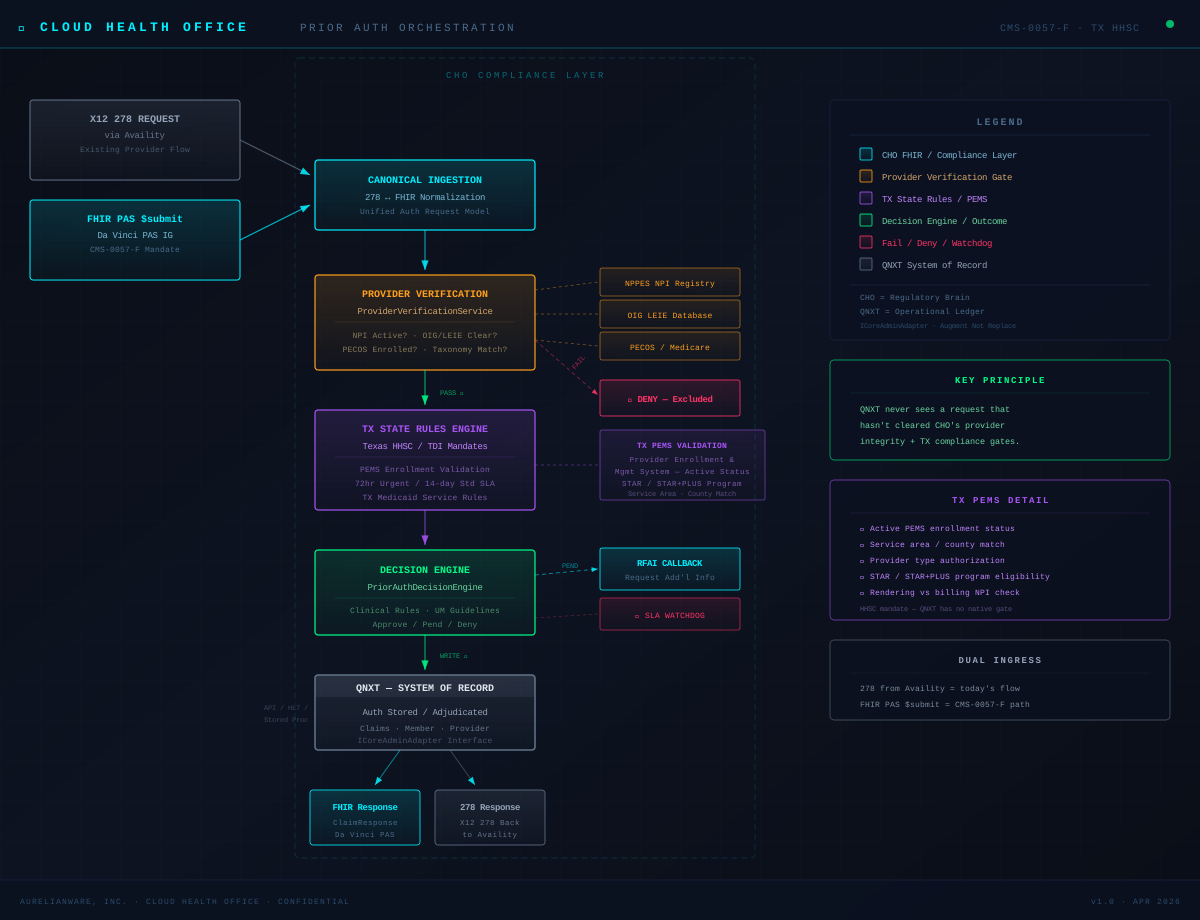
Augment-mode prior authorization flow with QNXT system-of-record integration
Adding Your State
CHO’s multi-state architecture is extensible. The same enrollment adapter, rule engine, and fee schedule pipeline pattern supports California (CA PAVE), Florida (FL FMMIS), and New York (eMedNY) today, with the same Source → Aggregator → Gate pattern.
Each new state requires:
- An
IEnrollmentSourceadapter for the state’s enrollment portal - State-specific seed rules in
SeedRules/implementing UMCM-equivalent regulations - Fee schedule rate tables from the state Medicaid agency
Contact us to discuss your state’s requirements.
Related Documentation
Provider Enrollment
Multi-state Medicaid enrollment verification, aggregation, and claims-gate integration.
View guide →Prior Authorization
PriorAuthRuleEngine, decision pathways, SLA tracking, and FHIR PAS integration.
View guide →Fee Schedule Engine
Rate table management, repricing pipeline, and program-specific fee resolution.
View guide →CMS-0057-F Compliance
Federal compliance requirements, FHIR R4 APIs, and interoperability standards.
View guide →